
4.64 out of 5 · 295 Google reviews
4.64 / 5 · Google
295 reviews across Milton & Scarborough.
Composite vs Porcelain Veneers: Which Is Right for You?
Composite veneers are tooth-coloured resin applied and sculpted directly onto the tooth in a single appointment, while porcelain veneers are ceramic shells made in a dental laboratory over two or three visits. Composite needs minimal or no enamel removal and can be repaired by adding resin; porcelain resists staining better and more closely mimics the translucency of natural enamel. Porcelain preparation removes roughly 0.5 mm of enamel, which cannot be restored.

Orion Dental Team
Led by Dr. Fahimay Naqvi
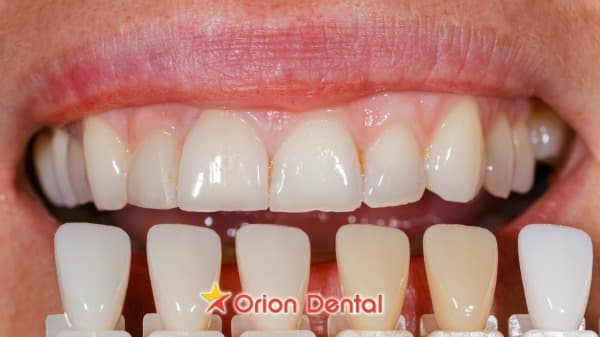
If you have been considering veneers to improve the appearance of your smile, you have likely come across two main options: composite veneers and porcelain veneers. Both can address common cosmetic concerns like discolouration, chips, gaps, and uneven teeth — but they differ significantly in materials, process, cost, and longevity.
At Orion Dental in Scarborough and Milton, we help patients understand their options and choose the approach that aligns with their goals, budget, and dental health. This guide provides a thorough comparison to help you prepare for that conversation.
Shorter
expected composite veneer life
Longer
expected porcelain veneer life
1 visit
for composite veneers
2–3
visits for porcelain
What Are Dental Veneers?
Dental veneers are thin, custom-made shells designed to cover the front surface of your teeth. They can change the colour, shape, size, and length of your teeth, creating a more uniform and attractive smile. Veneers are one of the most popular cosmetic dentistry treatments because they offer dramatic improvements with relatively conservative preparation.
The two primary materials used for veneers — composite resin and porcelain — each have distinct advantages. Your choice will depend on factors like your budget, the number of teeth involved, how quickly you need results, and your long-term aesthetic goals.
Composite Veneers: The Direct Approach
Composite veneers are made from a tooth-coloured resin — the same material used in cosmetic bonding. The resin is applied directly to your teeth, sculpted by hand, and hardened with a curing light. This process is sometimes called “direct veneers” because the material is built up on the tooth in the dental chair, without the need for a dental laboratory.
Composite Veneer Advantages
- Typically completed in a single appointment
- Less expensive per tooth than porcelain
- Minimal or no enamel removal required
- Easier to repair if chipped — resin can be added
- Good option for addressing one or two teeth
- More conservative and potentially reversible
The process is straightforward: your dentist selects a resin shade that matches your teeth, applies a bonding agent, then layers the composite resin onto the tooth surface. Each layer is shaped and cured with a special light before the next layer is added. Finally, the veneer is polished to a natural-looking finish. The entire procedure can take as little as 30 to 60 minutes per tooth.
Good to Know
Composite veneers are more susceptible to staining over time than porcelain. Regular polishing during dental cleanings can help maintain their appearance, but they may need to be replaced sooner than porcelain alternatives.
Porcelain Veneers: The Indirect Approach
Porcelain veneers are fabricated in a dental laboratory from high-quality ceramic material. The process typically requires two to three appointments: one for preparation and impressions, and another for bonding the finished veneers to your teeth. Temporary veneers are worn in the interim.
During the preparation appointment, your dentist removes a thin layer of enamel (typically 0.5 mm) from the front of each tooth to create space for the veneer. Impressions are taken and sent to the lab, where skilled technicians craft each veneer to match the desired shape, size, and colour. This lab-fabrication process allows for exceptional detail and translucency that closely mimics natural tooth enamel.
Porcelain Veneer Advantages
- Highly stain-resistant — maintains colour over many years
- Greater translucency mimics the look of natural enamel
- Generally longer-lasting than composite
- Ideal for a full smile transformation (6–10 front teeth)
- Durable against normal biting forces
- Smooth surface that resists plaque accumulation
The Porcelain Veneer Process
Consultation & Planning
Your dentist evaluates your teeth, discusses goals, and creates a treatment plan. Shade selection occurs here.
Tooth Preparation
A thin layer of enamel is removed. Impressions are taken and sent to the laboratory. Temporary veneers are placed.
Laboratory Fabrication
Technicians craft your custom porcelain veneers over 1–2 weeks, matching your precise specifications.
Bonding & Final Fit
Temporary veneers are removed. Permanent veneers are tried in, adjusted, and bonded with dental cement.
Side-by-Side Comparison
This table highlights the key differences between composite and porcelain veneers:
| Feature | Composite Veneers | Porcelain Veneers |
|---|---|---|
| Material | Resin (ceramic + plastic blend) | Dental ceramic / porcelain |
| Appointments needed | 1 (direct application) | 2–3 (includes lab fabrication) |
| Enamel removal | Minimal or none | Thin layer (≈ 0.5 mm) |
| Lifespan | Shorter; may need repair sooner | Generally longer; varies by patient |
| Stain resistance | Moderate — may discolour over time | High — highly stain-resistant |
| Repairability | Easy — resin can be added or reshaped | Difficult — typically requires replacement |
| Natural appearance | Good | Excellent — greater translucency |
| Reversibility | Often reversible | Generally irreversible |
| Cost per tooth | Lower | Higher |
Not Sure Which Veneer Is Right for You?
Book a veneer consultation at Orion Dental. We will help you understand your options and choose the right approach.
Important Considerations Before Choosing Veneers
Regardless of which type you choose, there are several important factors to keep in mind:
Veneers Require Maintenance
Both types need regular dental care. Avoid biting hard objects like ice, pen caps, or fingernails to prevent chips.
Night Guards May Be Needed
If you grind or clench your teeth, a custom night guard can protect your veneers from excessive force during sleep.
Enamel Removal Is Permanent
For porcelain veneers, the thin layer of enamel removed cannot grow back. This makes the procedure largely irreversible.
Cavities Can Still Develop
Veneers cover the front surface but do not protect the entire tooth. Good oral hygiene remains essential.
Insurance Rarely Covers Veneers
Most cosmetic treatments are considered elective and are not covered by dental insurance. Ask about payment plans.
Results Depend on Planning
The outcome relies heavily on proper assessment, shade matching, and your dentist's skill. A thorough consultation is essential.
Important Reminder
Veneers are not a substitute for addressing underlying dental issues. Cavities, gum disease, and bite problems should be treated before any cosmetic work begins. Your dentist will perform a thorough examination to ensure your teeth and gums are healthy enough for veneers.
Which Type Is Right for You?
The right choice depends on your individual situation. Here are some general guidelines:
Composite veneers may be a good fit if: you want to address one or two teeth, you prefer a more conservative approach with minimal enamel removal, you have a tighter budget, or you want the option of reversibility.
Porcelain veneers may be a good fit if: you want a comprehensive smile transformation across multiple teeth, you prioritise longevity and stain resistance, you want the most natural-looking result possible, or you are willing to invest in a longer-lasting solution.
In some cases, your dentist may recommend a combination — for example, porcelain veneers on your most visible front teeth and composite bonding on less prominent teeth. A smile makeover consultation can help determine the ideal treatment plan.
Book Your Veneer Consultation
Whether you are leaning toward composite or porcelain — or simply want to explore your options — the next step is a conversation with your dental team. At Orion Dental, we will assess your oral health, discuss your aesthetic goals, and recommend the veneer approach that makes sense for you.
Schedule a consultation at our Scarborough or Milton office. Book an appointment or call 416-291-0306 (Scarborough) / 905-636-9770 (Milton).
Frequently Asked Questions
Common questions about dental veneers
How long do porcelain veneers last?
With proper care — including good oral hygiene, avoiding biting hard objects, and wearing a night guard if you grind your teeth — porcelain veneers can last many years before needing replacement. How long varies from person to person.
How long do composite veneers last?
Composite veneers generally do not last as long as porcelain veneers, and how long they last depends on your oral habits and how well you maintain them. They may require periodic polishing or repair.
Are veneers reversible?
Porcelain veneers are generally not reversible because a thin layer of enamel is removed during preparation. Composite veneers may involve minimal or no enamel removal, making them a more conservative option.
Do veneers look natural?
Both types can look very natural when placed by a skilled dentist. Porcelain veneers tend to mimic natural tooth translucency more closely, while composite veneers rely on the dentist's artistry during direct application.
Can I get veneers if I grind my teeth?
Yes, but your dentist will likely recommend a custom night guard to protect your veneers from the forces of grinding and clenching. Without one, veneers may chip or crack prematurely.
How much do veneers cost in Ontario?
Costs vary depending on the type and number of veneers needed. Composite veneers are generally less expensive per tooth than porcelain. Most cosmetic veneer work is not covered by dental insurance. Your dentist can provide a detailed estimate during your consultation.
Related Articles
Continue reading about cosmetic dentistry
How Cosmetic Dentistry Can Help Your Smile
A comprehensive look at cosmetic treatments including whitening, implants, crowns, and bonding.
Read moreCosmetic Dental Procedures Available in Ontario
Overview of the full range of cosmetic dental treatments offered in Ontario dental practices.
Read more5 Reasons to Whiten Your Teeth Professionally
Professional whitening may be a simpler first step before considering veneers.
Read more